A VOC ship that never sinks
At Het Scheepvaartmuseum in Amsterdam you walk through the illusion of a VOC ship, built from more than a thousand knitted strips in gold and crimson. The installation Crimson Gilt is on show until 21 March 2027.
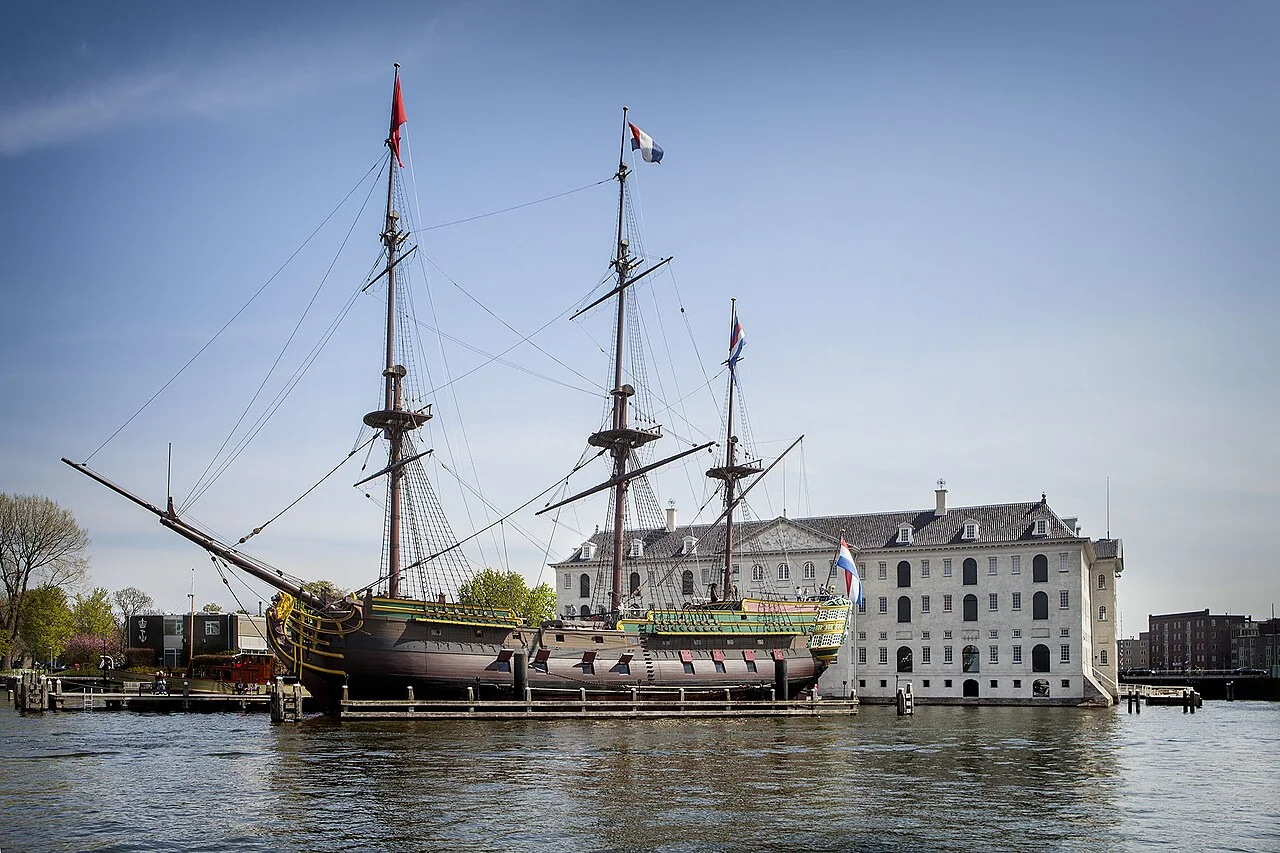
Visitors to Het Scheepvaartmuseum in Amsterdam can walk through a ship that is not there. It is an illusion, built from more than a thousand knitted strips in gold and crimson. The installation is called Crimson Gilt and stands in a space overlooking the replica of the VOC ship Amsterdam next to the museum. It is on show until 21 March 2027.
The colours carry the message. The gold stands for prosperity and trade, the red for colonialism and exploitation. Together they show the tension and complexity of a shared but unequal history. The real Amsterdam, built in 1748, sank on her maiden voyage to Batavia. In Dutch and Japanese narratives the ship is seen as a symbol of maritime skill, in Indonesia as a symbol of exploitation and of the beginning of three and a half centuries of colonial domination.

The replica at the jetty dates from later. It was built in the 1980s, a time of high unemployment, and has lain at the museum’s jetty since 1989. What began as an employment project for young people has grown into a place to learn more about the ships and trade routes of the VOC and the violence that went with them. Since 2022 new flags by the artists’ collective Sites of Memory have flown on the ship, part of the installation Decoding the Atlantic World. For that installation the collective devised a new signal-flag language, with a message on the largest flag that visitors can decipher. The real Amsterdam was built in the eighteenth century on behalf of the VOC, a company with a large network in Asia.
The maker of Crimson Gilt is Vincent Ruijters, born in The Hague in 1988. He makes large-scale, site-specific art installations, poetic, conceptual and technologically inflected. His father is Dutch, his mother Chinese-Indonesian. In search of his Asian identity he moved to Japan for ten years, where he worked on technological media installations. Back in the Netherlands his work turned to hybrid identity. In 2025 he joined the advisory group of the National Knowledge Programme on the History of the Dutch East Indies/Indonesia.
About his starting point he says: ‘I have a Dutch and Chinese-Indonesian family history. The question I want to ask with this artwork is: how do we navigate our collective memory as we move towards the future?’
Amsterdam is not the work’s first stop. It was previously shown in Hirado in Japan, on the site of the former VOC trading post, and at the maritime museum in Jakarta, from 7 February to 7 April 2026. In this way the project links three countries that were once connected by the trading network of the VOC: Japan, Indonesia and the Netherlands. A soundscape and a video connect the three locations. Each chapter is staged at a historically charged site: the former VOC trading post in Hirado, the Museum Kebaharian Jakarta and the National Maritime Museum in Amsterdam.
The colour changes from place to place. In Jakarta the ship was red at the front and gold inside, an image of visible suffering and extracted wealth. In Hirado it gleamed metallic gold from the front, and while walking through the installation the gold slowly turned dark red. That shift raises the question of how countries linked by the same sea routes remember the same history differently.
For Indonesia ships once stood for connection: they linked kingdoms, made the exchange of ideas possible and formed the basis of cultural and economic networks between the islands. The arrival of the VOC changed that symbolism. Ships became instruments of monopoly, control and imperial expansion. The text accompanying the presentation in Jakarta says that the arrival of the VOC opened the door to colonialism in Indonesia, with social and political consequences that remain relevant today. The presentation in Jakarta coincided with the run-up to that city’s five-hundredth anniversary (1527-2027). The set-up gives art a second task: it aims to be a place where knowledge arises and collective memory is negotiated.
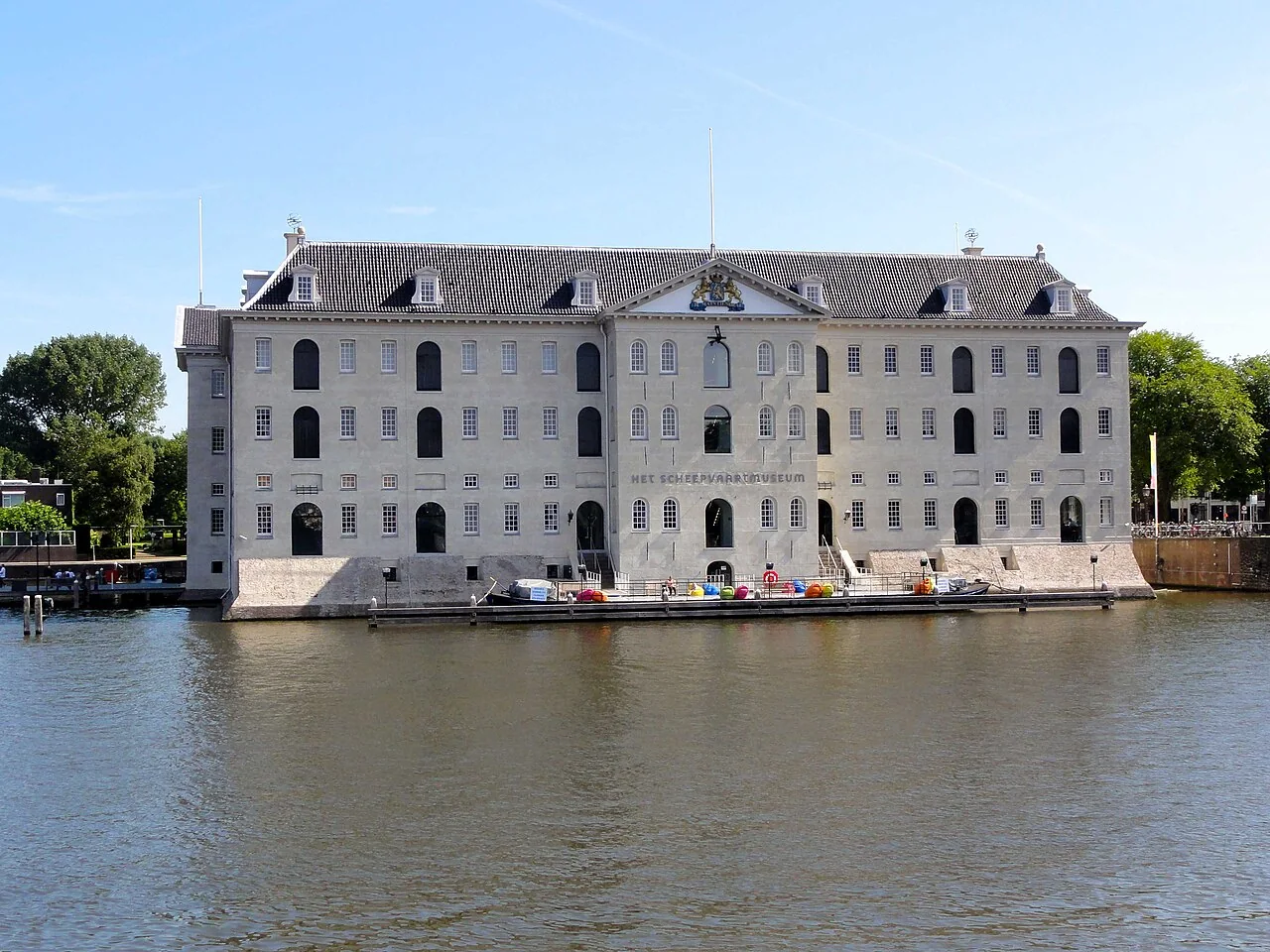
Het Scheepvaartmuseum is at Kattenburgerplein 1 in Amsterdam and is open Monday to Sunday from 10:00 to 17:00. The installation is made possible in part by the participants of the VriendenLoterij.
In Ruijters’ reimagining the Amsterdam never sinks. She completes her journey, from Amsterdam to Hirado, to Jakarta and back again. In Crimson Gilt the ship does not simply return to port. It returns to memory.
Practical
Where: Het Scheepvaartmuseum, Kattenburgerplein 1, 1018 KK Amsterdam
Runs until: 21 March 2027
Open: Monday to Sunday 10:00-17:00
Artist: Vincent Ruijters (The Hague, 1988)
Previously shown in Hirado (Japan) and Jakarta (Indonesia)