
Until recently one Frankenthaler against more than forty Judds
In Amersfoort, work by Helen Frankenthaler hangs alongside sculptures by Donald Judd, two artists who were received very differently in the Netherlands. The exhibition runs from 26 September 2026 to 10 January 2027.
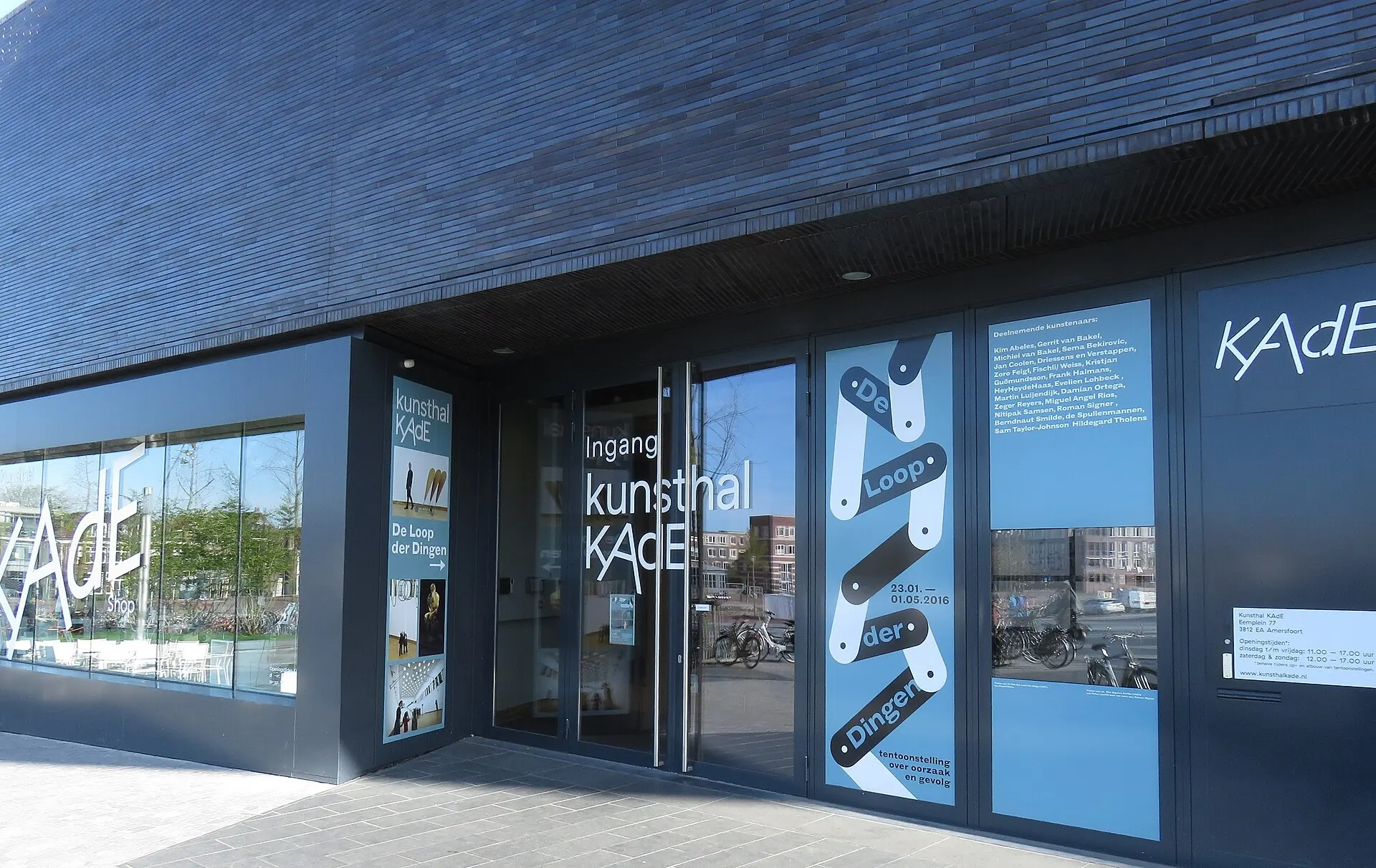
Two aluminium sculptures by Donald Judd stand together again in Amersfoort for the first time since they were bought. One is nine metres wide and one and a half metres high and comes from Museum Boijmans Van Beuningen in Rotterdam, where it has been in the collection since 1984. The other is just over seven and a half metres wide and comes from the Stedelijk Museum in Amsterdam, which in 1994 bought a version of the Rotterdam work in a different colour scheme. You can see them in Frankenthaler / Judd at Kunsthal KAdE.
Helen Frankenthaler and Donald Judd were born in the same year, 1928, and both broke through in postwar New York. In the United States they were very successful, but in Europe it was different, especially in the Netherlands. Judd's minimalist work was exhibited and collected on a large scale from the early 1970s. Art historian and curator Rudi Fuchs was a fervent supporter and bought works for the museums in Eindhoven, The Hague and Amsterdam. Together the large Dutch museums own more than forty works by Judd, including nineteen sculptures, seven of them large-scale. Of Frankenthaler's work, until recently only the Stedelijk Museum owned a single print, from a portfolio of American artists and acquired after her death. Only in 2025 were two paintings added. The work of colleagues such as Lee Krasner, Joan Mitchell, Grace Hartigan and Elaine De Kooning is still missing from Dutch collections.
In the galleries you see how different their work is. With generous gestures Frankenthaler applied bright colours to large canvases, sometimes with her soak-stain technique, in which the paint was absorbed into the canvas and spread across the surface. Judd became one of the leading figures of minimalism and made tightly ordered geometric forms, often from industrial materials and assembled by others. The kunsthal lines up the contrasts: free form against strict visual language, intuition against reason, personal gestures against an ‘industrial’ attitude. Collecting also differed: one was undervalued and therefore not collected, the other was popular and bought time and again. There are similarities too. Frankenthaler regularly used rectangular and square fields and sometimes flirted with minimalism. Towards the end of his career Judd began to use more and more expressive colours.
That they did not follow each other does not mean they did not know each other. In the early 1960s Judd wrote hundreds of reviews for Arts Magazine, partly to see a great deal of art, partly to sharpen his own artistic profile. Between 1960 and 1963 he wrote three reviews of Frankenthaler exhibitions, which grew gradually more critical. Around 1960 the New York art scene was in flux. Frankenthaler already had several exhibitions behind her, partly thanks to her early ties with the abstract expressionists and critics such as Clement Greenberg, while Judd was still searching for his definitive artistic voice.
In the Elleboogkerk in Amersfoort hangs the work of an artist you could see as a contemporary Frankenthaler: Vivian Suter, born in 1949 in Buenos Aires. Her installation Stone in the Pond (2026) consists of dozens of canvases, not stretched but hanging freely in the space. Suter lives in the jungle of Guatemala and paints outdoors in nature. Almost every day she leaves her house late in the afternoon, climbs 120 steep stone steps to the one-room studio on a hill and paints until long after sunset. There is no electricity, no lamp, and often she cannot even see what she has made. ‘I actually only know what they look like when I see them in the light,’ Suter said. Like Frankenthaler, who painted her canvases on the floor and decided the top and bottom later, she keeps the orientation of a work open for a long time.
Frankenthaler / Judd runs from 26 September 2026 to 10 January 2027 at Kunsthal KAdE, Eemplein 77 in the Eemhuis in Amersfoort. The kunsthal is open Tuesday to Sunday from 10.00 to 17.00 and closed on Monday, Christmas Day and New Year's Day. On 5, 24 and 31 December KAdE closes an hour earlier; on Boxing Day (second Christmas Day) the kunsthal is open from 10.00 to 17.00. From 11 January to 5 February 2027 KAdE is closed for a changeover period. For this exhibition you pay the regular ticket price plus a € 3.00 surcharge: an adult pays € 20.00 in total, and with a Museumkaart the surcharge is € 3.00. On a repeat visit you do not pay the surcharge again. Suter's installation can be seen from 26 September 2026 to 2 May 2027, Tuesday to Sunday from 10.00 to 17.00, at Langegracht 36; up to and including age 24 the Elleboogkerk is free.
Minimalism, with the conceptualism that grew out of it, and abstract expressionism were the bookends of postwar Western art history. The kunsthal calls the exhibition a reflection on that history, and on the choices Dutch museums made within it.
Practical
Kunsthal: Kunsthal KAdE, Eemplein 77 (Eemhuis), 3812 EA Amersfoort
Exhibition: Frankenthaler / Judd
On view: 26 September 2026 to 10 January 2027
Open: Tuesday to Sunday 10.00-17.00; closed on Mondays
Holidays: closes an hour earlier on 5, 24 and 31 December; closed on Christmas Day and New Year's Day; open on Boxing Day 10.00-17.00
Tickets: adult € 20.00 including € 3.00 surcharge; Museumkaart plus € 3.00 surcharge
Also on view: Vivian Suter, Stone in the Pond, Elleboogkerk, Langegracht 36, until 2 May 2027