
An etching on linen, then coloured by hand
Hercules Segers sometimes printed his etchings on linen instead of paper. The Rembrandt House shows one in Experimentation, until 3 January 2027.
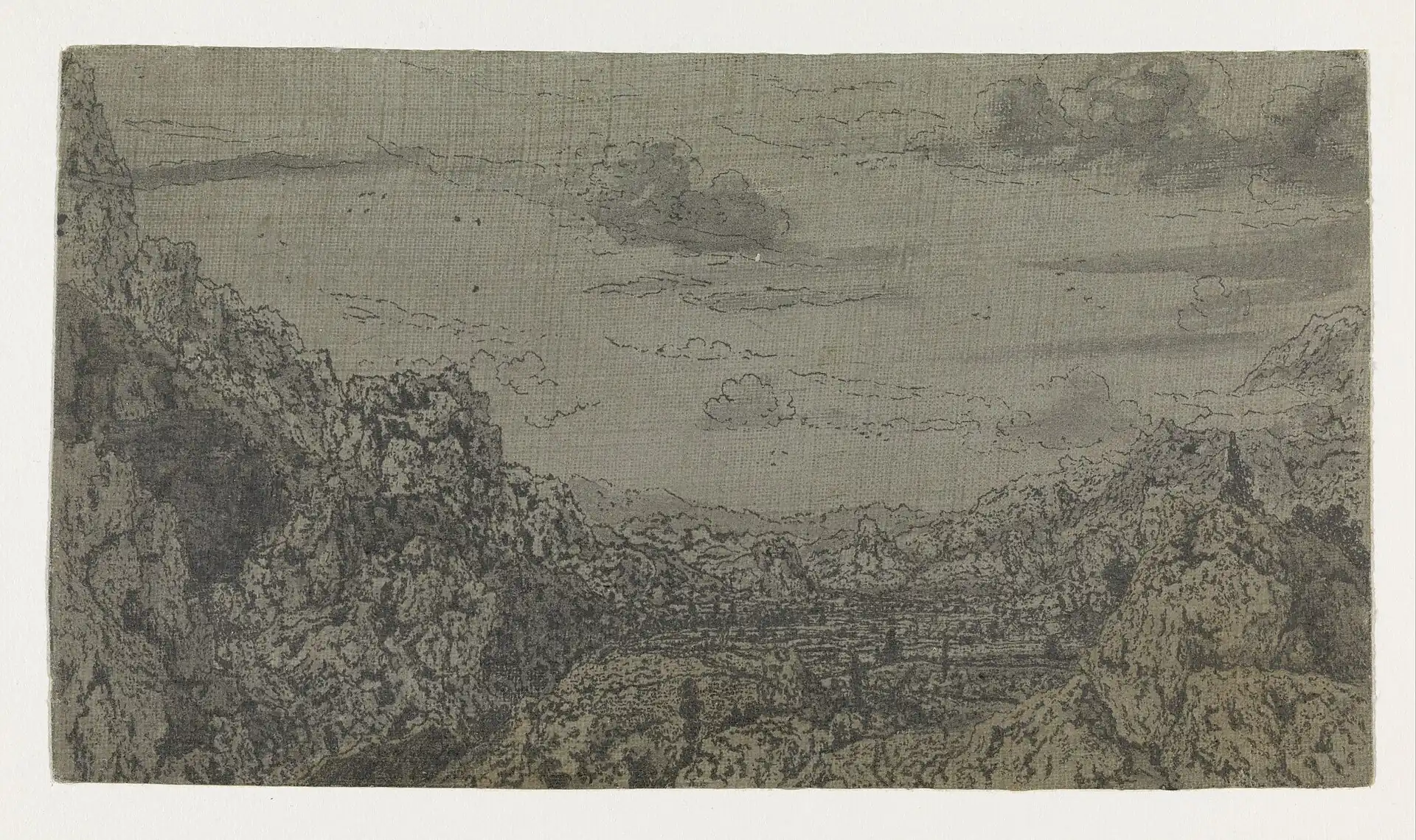
The earliest impressions of The Enclosed Valley are printed on linen. The Rijksmuseum describes the print as a line etching, printed in black on linen, and then worked by hand. Hercules Segers painted the foreground brown and the background grey or blue, giving the print a subtle colour perspective. The print was made around 1625-1630 and the sheet measures 108 by 194 millimetres.
For this he used transparent light brown, a more opaque dark grey and transparent light grey. It is thus not a colour print but a black-and-white etching that is painted afterwards.
Another Segers print in the Rijksmuseum shows a different recipe. Ruins of the Abbey of Rijnsburg, Small Version, from around 1618-1622, is likewise printed in black on linen with a bluish-grey ground. Here he coloured with transparent bluish-grey and yellow paint. The sheet measures 96 by 175 millimetres.
An etching on linen also hangs in the Rembrandt House, in the exhibition Experimentation: Landscape with a Spruce Branch, 1625-1630. Segers hangs there next to Rembrandt, Geertruydt Roghman, Willem den Ouden, Glenn Brown and Guy Vording, artists who all made works on paper and experimented without holding back. The exhibition runs from 19 September 2026 to 3 January 2027.
Practical
Print: Hercules Segers, The Enclosed Valley, c. 1625-1630, 108 x 194 mm, Rijksmuseum
Technique: line etching, printed in black on linen, coloured by hand
At the Rembrandt House: Landscape with a Spruce Branch (etching on linen), until 3 January 2027
Address: Jodenbreestraat 4, Amsterdam