Why is there a skull among the dice?
A skull, a lamp, soap bubbles and a globe: seventeenth-century painters gathered the transient on a single panel. What do those objects mean in a vanitas still life?
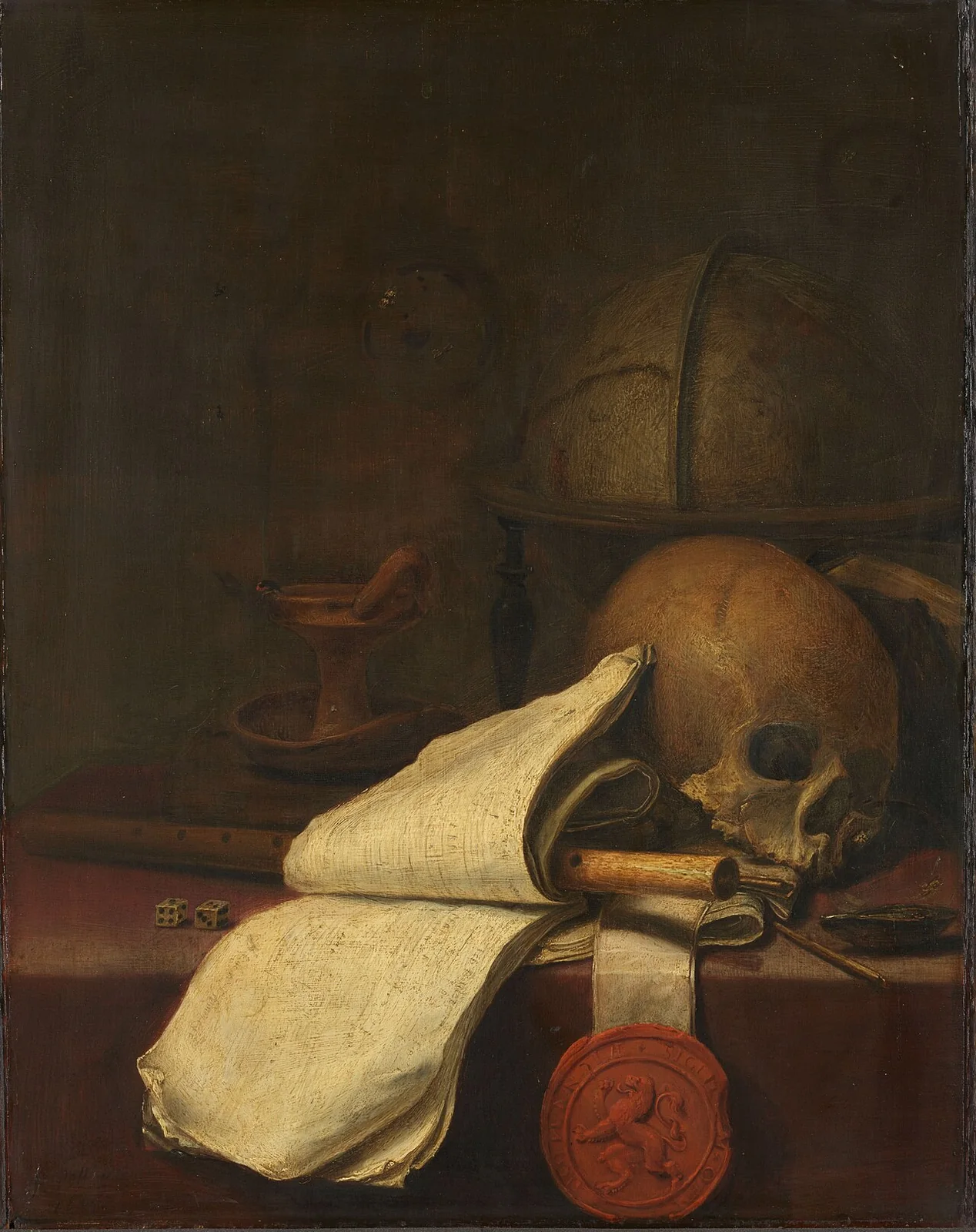
Soap bubbles, dice, an oil lamp, a skull, a songbook, a flute and a globe: they are all in one painting by Pieter Symonsz Potter from 1646. It is on loan from the City of Amsterdam to the Rijksmuseum and is a vanitas still life. Such a still life shows without words that life is short.
The word vanitas comes from the biblical book Ecclesiastes. The Latin sentence reads Vanitas vanitatum et omnia vanitas. The Royal Museum of Fine Arts Antwerp calls the skull the central symbol of death. Around that skull painters placed objects that show transience in other ways. The Antwerp vanitas still lifes hang on the second floor, in Zaal Z. Siska Beele wrote the text about the genre for ZAAL Z, the museum’s magazine.

Potter’s painting measures 53.5 by 41.4 centimetres, oil on panel, and his signature and the date are at the bottom left. The Rijksmuseum reads the objects like this: skull, lamp, soap bubbles and old books refer to mortality, and the dice, the flute and the music book show that human pleasures are relative. The large seal on the document is the Great Seal of the United Provinces. The museum sees in it a warning to treat the existence of the Republic with care.
Potter (Enkhuizen, around 1597/1600 – Amsterdam 1652) painted more vanitas still lifes, including in 1636 and 1638. This work from 1646 is later, more monochrome and brown in tone, and unusually vertical in format. The painting’s provenance can be traced to the seventeenth-century estate of Adriana Balckeneynde, the wife of Potter’s son Paulus.
The soap bubbles stand for fragility. The Antwerp museum links them to Erasmus and to Lucian of Samosata and his saying homo bulla: man is a bubble.
The National Gallery in London has a vanitas by Harmen Steenwyck (1612-1656), painted around 1640 in oil on wood, 39.2 by 50.7 centimetres. The museum calls the skull a reminder of mortality and writes that we are staring death in the face. A lamp with a wisp of smoke stands for a life that has just been extinguished. A pocket watch stands for relentless time. Two books, one new and unread and one well-thumbed, refer to learning and intellectual effort and also to ageing. A recorder, a lute and a shawm stand for the ephemeral pleasures of music, an earthenware flask for those of wine. A Japanese sword in a lacquered sheath stands for luxury and power, and an exotic sea shell for a rare collector’s item and, like the skull, for lost life.
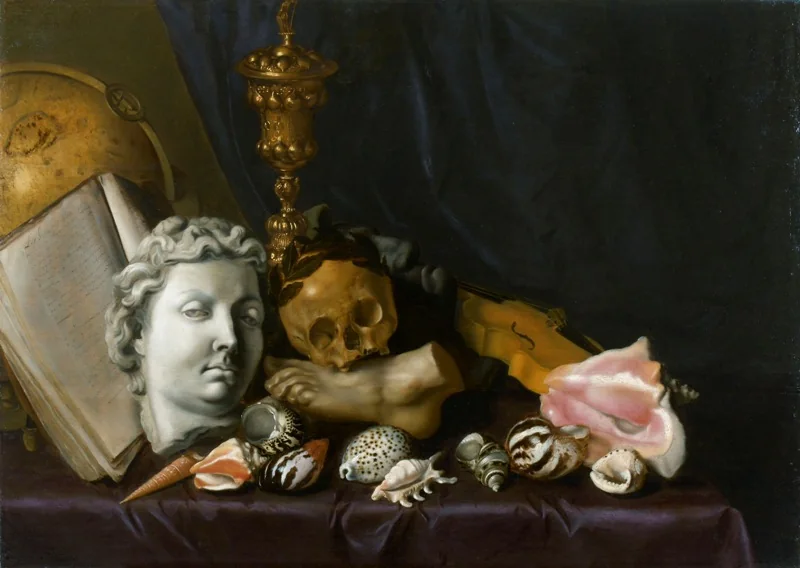
The Fries Museum in Leeuwarden has a vanitas still life by Dirck de Horn, from around 1650. At first it looks like a table crowded with unusual objects, and the museum says a seventeenth-century viewer recognised the message at once. A silenced violin, a laurel-wreathed skull and empty seashells depict mortality, death prevailing over life. Two plaster heads and a foot refer to sculpture, the violin to music and the globe to astronomy and thus science. Gleaming gold goblets and shells show how well the painter could render reflective surfaces. The painting is thus also a tribute to science and art.
The Antwerp text lists more symbols. Hourglasses and dying candles mark the passing of time. A cracked marble tabletop shows that even hard stone is transient. A pipe, tobacco and musical instruments stand for fleeting pleasures. A royal proclamation with a seal and a globe point to power and wealth. Books, spectacles and writing tools stand for knowledge and wisdom, which also have limits. Rotting fruit, fallen petals and cracks in porcelain add a moral undertone. Ears of wheat around the skull represent the Christian hope in the Resurrection and the reward of a virtuous life. The text also names Franciscus Gijsbrechts (1649 to after 1677) as a painter of vanitas still lifes.
The National Gallery describes a vanitas as a genre that sets worldly pleasures, possessions and endeavours, which the museum calls ephemeral and futile, against the everlasting nature of faith. That contrast is also in the ears of wheat around the skull in some still lifes: the Christian hope in the Resurrection.
Potter’s painting is in the Rijksmuseum’s collection under object number SK-C-204. The museum rates its condition as fair. The date is at the bottom left, next to the signature: 1646.
Practical
Potter: Vanitas Still Life, 1646, oil on panel, 53.5 x 41.4 cm, Rijksmuseum (SK-C-204), on loan from the City of Amsterdam
Dirck de Horn: Vanitas Still Life, around 1650, Fries Museum, Leeuwarden
Harmen Steenwyck: vanitas, around 1640, National Gallery, London
Vanitas: from Ecclesiastes, 'Vanitas vanitatum et omnia vanitas'