Whistler came to the Netherlands at least eleven times
Until 10 January 2027 the Van Gogh Museum and The Mesdag Collection together stage the first Dutch Whistler retrospective: a dandy, a quarreller and a painter of mist and light.

In 1889 James McNeill Whistler sits in a boat on the Amsterdam canals and etches a city from which the famous gables are deliberately missing. What remains is light, shadow and texture. He himself called his Amsterdam series his best work to date. That Dutch side of Whistler can be seen this autumn in two exhibitions that tell one story: a large one at the Van Gogh Museum in Amsterdam and a smaller one at The Mesdag Collection in The Hague. Both run from 16 October 2026 to 10 January 2027.
Whistler (1834-1903) was born in the United States, moved to Paris at twenty-one and then divided his time between Paris and London for nearly fifty years. He moved in the circles of Dante Gabriel Rossetti, Gustave Courbet, Edouard Manet and Oscar Wilde. The museum calls him a master of self-promotion, an outspoken dandy with exquisite taste and a man notorious for his quarrels.

Those quarrels shaped his career. He fiercely defended his view of art, even at the cost of bankruptcy. When the critic John Ruskin compared his work to flinging a pot of paint in the public’s face, Whistler sued him for libel. The museum calls that a watershed in art history. His own account of all those disputes carried the telling title The Gentle Art of Making Enemies. The English art critic Roger Fry summed up his attitude: Whistler always seemed to be inaugurating a revolution, leading intransigent youth against the strongholds of tradition and academic complacence.
The Van Gogh Museum shows some 100 works, including Arrangement in Grey and Black: Portrait of the Painter’s Mother. There are also dreamlike nocturnes of the Thames, works from the series White Girls and life-sized society portraits. The museum writes that Whistler spent months, sometimes years, on a single work, while the finished piece looks almost effortless. His conviction was that art, like music, should above all evoke a mood. The museum’s website has a separate page on the music that inspired him. Besides paintings he is known for his many etchings and drawings, made in cities such as Paris, Amsterdam and Venice.
Vincent van Gogh admired Whistler. He mentioned his etchings in several letters and counted him among the artists he and his brother Theo had ‘loved in our time’. Both were fascinated by Japanese aesthetics and pushed the boundaries of what art could be. In a letter to his sister Willemien, Van Gogh referred to the portrait of Whistler’s mother and wrote that when he thinks of his own mother, she appears to him like that too.
The exhibition in The Hague, Whistler. Loving the Netherlands, focuses on his bond with this country. Whistler visited the Netherlands at least eleven times between 1863 and 1902. Rembrandt was his great inspiration and he valued old Dutch paper for the warm glow it gave his etchings. ‘Holland is the country for artists. It has atmosphere’, he wrote. He worked in places including Dordrecht and Zeeland, and his eye for the watery landscape prompted Dutch artists to paint atmospheric waterscapes of their own, such as Willem Witsen and George Hendrik Breitner. He was in regular contact with Hendrik Willem Mesdag, who likely encouraged him to paint the Scheveningen coastline and the North Sea. On his final day in the Netherlands, Whistler visited Museum Mesdag, where the works and stories of his Dutch years are now on view. There you see his etchings, refined watercolours and small-scale paintings next to the work of Dutch contemporaries, with loans from, among others, the Amsterdam City Archives and the Rijksmuseum. A booklet with all the gallery texts in large print is available at the information desk.
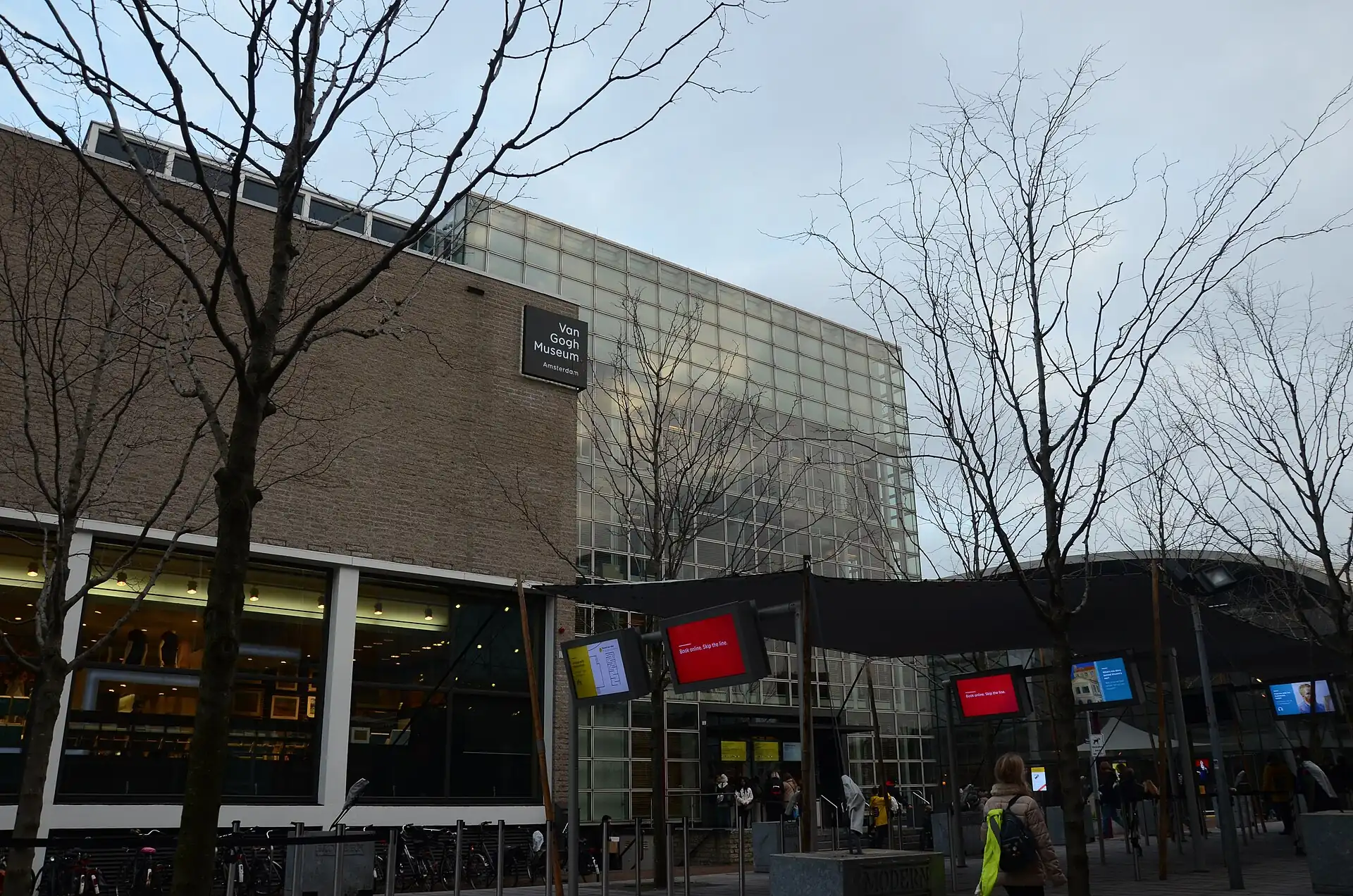
The exhibition was organised with Tate Britain in London and curated by Edwin Becker (Van Gogh Museum), Renske Suijver (The Mesdag Collection) and Carol Jacobi (Tate Britain). An audio tour accompanies it, and the museum runs painting workshops in which visitors make their own nocturne, a night landscape. The Van Gogh Museum, Museumplein 6, is open daily from 9.00 to 17.00 from 2 November, on Fridays until 21.00 except on 27 November. The same hours apply from 1 to 18 December. Both exhibitions close on 10 January 2027.
Practical
Where: Van Gogh Museum, Museumplein 6, Amsterdam (Whistler. Dandy and Disruptor)
Also on view: The Mesdag Collection, The Hague (Whistler. Loving the Netherlands)
Until: 10 January 2027, from 16 October 2026
Open: daily 9.00-17.00 from 2 November to 18 December, Fridays until 21.00 (not on 27 November)
Around 100 works, with an audio tour