Yuki Kihara plays Charles Darwin in Leiden
At Wereldmuseum Leiden, Yuki Kihara puts Gauguin and Darwin in a different light, with photographs, videos and twelve embroidered mats. It is her first solo show in the Netherlands, on view until 3 January 2027.
In a carefully staged landscape stands a group of figures. Their poses are stately, almost classical, as though they have stepped straight out of a nineteenth-century painting. The image feels familiar: it recalls the idyllic scenes of Polynesia painted by the French artist Paul Gauguin. But on closer inspection something has shifted. That is how Wereldmuseum Leiden describes one of the photographs in Yuki Kihara’s Paradise Camp series.
Gauguin painted in Tahiti and the Marquesas Islands between 1891 and 1903. With his images of Polynesian women, rendered as sensual and exotic, he played a major role in shaping the Western image of Oceania. Kihara reverses that. In a series of photographs she restages his compositions with models from the Sāmoan fa’afafine community, to which she herself belongs. Fa’afafine means ‘in the manner of a woman’ and is a recognised non-binary gender identity. The gaze thus shifts from exoticisation to self-representation.

In the video series First Impressions, members of the fa’afafine community see a painting by Gauguin for the first time and tell what they see. In Talanoa between Yuki Kihara and Paul Gauguin (2022), Kihara talks to the painter in an imagined interview. Paradise Camp was shown in the Aotearoa New Zealand Pavilion at the 59th Venice Biennale in 2022 and was widely praised there.
The second subject is science. In the video installation Darwin Drag, Kihara herself plays Charles Darwin, using humour and theatrical means. Darwin developed the theory of evolution by natural selection together with Alfred Russel Wallace. More recent studies by biologists such as Ross Brooks and Joan Roughgarden show that the animal kingdom has far greater diversity in sexuality and gender than Darwin described. By putting Darwin literally and figuratively in drag, Kihara shows how scientific knowledge is often shaped by the social norms of its time. She calls Darwin’s view not a neutral observation, but a reflection of the conservative values of his time.
New is Moana Queer Taxonomy (2026): twelve embroidered pandanus mats, known in Sāmoa as fala su’i, showing marine life around the Sāmoan islands. Biologists have found a wide range of sexual and gender diversity among these species: fish that change sex, species that show male and female characteristics at the same time or form long-term pairs with a partner of the same sex. Kihara shows the animals under their original Sāmoan names, and so shows that other ways of naming and classifying nature existed long before European taxonomies. The mats were made with the embroiderers of the Tovio family of the Moata’a Aualuma community on the island of Upolu, which gives the work a collective dimension.
Archival research runs through Kihara’s work like a thread. For Darwin in Paradise Camp she brings together historical photographs, books and documents in what she calls her vārchive, an archive that connects different times, stories and perspectives. Colonial photographs of Sāmoa and nineteenth-century missionary accounts show how European visitors tried to understand the islands from their own worldview. The museum writes that the same sources also show that local knowledge and traditions offer other ways of thinking about gender and nature.
The exhibition also touches on the climate. In Oceania the effects of climate change are already clearly visible: rising sea levels, coastal erosion and ever more intense cyclones. For Kihara these changes are closely linked to the colonial history of the region and to the way nature has been framed within Western knowledge and imagery. In the British edition at the Sainsbury Centre in Norwich it is noted that Pacific Islanders account for less than 0.02 per cent of global greenhouse gas emissions.
Kihara was born in Sāmoa and makes photographs, videos and installations. The show grew out of a British exhibition from 2025 and was shown, among other places, at The Whitworth in Manchester, from 3 October 2025 to 1 March 2026. The museum cites two reviews. The Observer wrote in February 2026 that the exhibition is at once playful, subversive and deeply moving. Art Review wrote in April 2025 that a reconsideration of what it means to be human requires ‘a reevaluation of the origin of the species’.
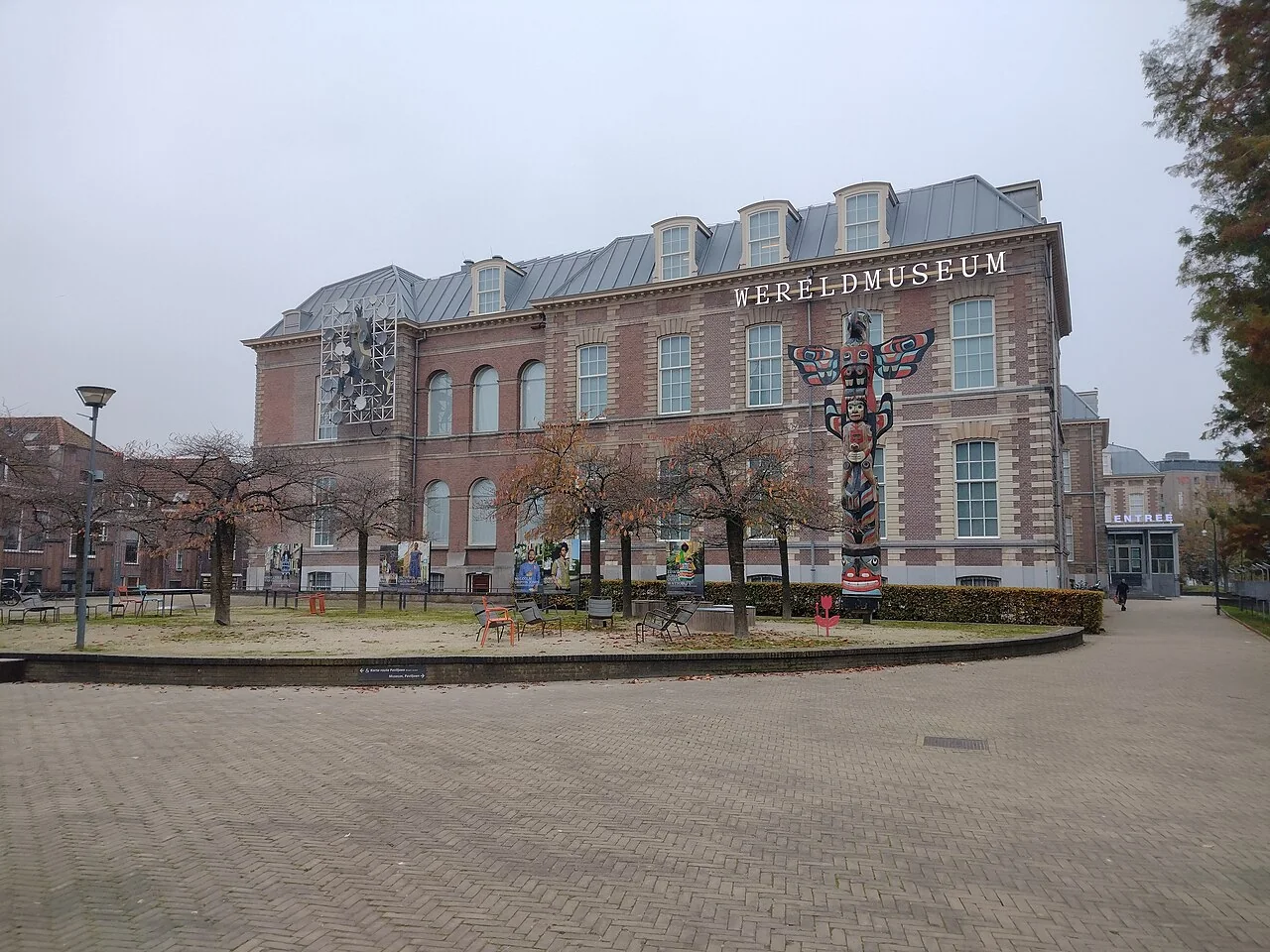
Wereldmuseum Leiden is at Steenstraat 1. The exhibition can be seen Tuesday to Sunday from 10:00 to 17:00, and on Mondays during national school holidays.
Practical
Where: Wereldmuseum Leiden, Steenstraat 1, 2312 BS Leiden
Until: 3 January 2027
Open: Tuesday to Sunday, 10:00-17:00; also Mondays during national school holidays
Yuki Kihara's first solo show in the Netherlands
New work: Moana Queer Taxonomy (2026), twelve embroidered mats