
An embrace made of wood in The Hague
Jakob Grosse-Ophoff was a mechanical engineer and now builds wooden sculptures that move. His first museum exhibition runs until 11 April 2027.
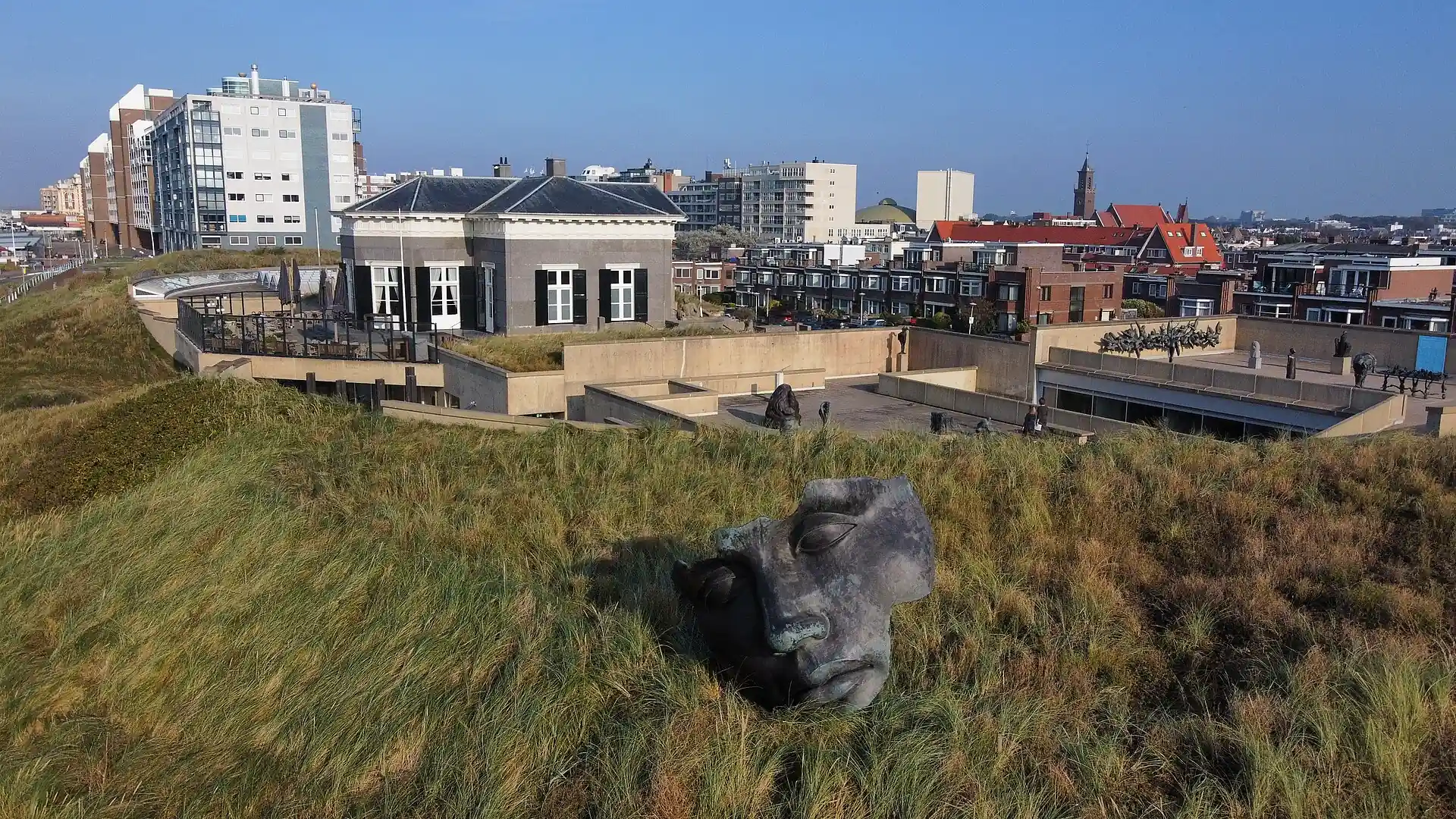
Visitors lean their chest against a wooden spring, and two wooden arms gently embrace them. Hugger (2025) engages the entire body and gives an embrace in return. The work is by Jakob Grosse-Ophoff and is on show in Myself and Other Planets, his first solo exhibition in a museum. It runs from 31 October 2026 to 11 April 2027 in the Zuidzaal of Museum Beelden aan Zee in The Hague. The curator is Iris van der Zee.
Grosse-Ophoff (Oldenburg, 1991) lives and works in Rostock. He makes kinetic sculptures, paintings and drawings. He studied mechanical engineering at the University of Rostock and graduated in 2019, with a focus on renewable energies and composite materials. After that he devoted himself fully to his art. Since then his work has been shown in Europe, the United States and South Korea. As a sculptor he is self-taught.
He picked up his skills early. As a child he could use his father’s workshop, and there are photos of him at the age of six working with wood. That he could become an artist did not occur to him for a long time. During an internship for his degree, the head of internships suggested he should be an artist. He still finished his degree first and right afterwards chose to be self-employed and publish art. He began with two-dimensional work, because it needed no workshop and almost no investment. He put photos of his drawings on Instagram and could soon make a living from his art. For a while he thought he might become a tree house builder and built tree houses in New Zealand. After that he spent a year and a half building a bar for a friend.
In his drawings everything already revolved around machines: gears, power transmission and power sources. After selling drawings at exhibitions for several years, it occurred to him that the apparatus could step out of the flat plane. His first three-dimensional, kinetic work is called The Tireless Dancer. A wooden head has an arm on either side, divided into four segments that rise and fall via bars connected to a turning, twisted axle. This way the arms make the movement a breakdancer would call an arm wave. His second work, Self-reflection, is a study of a gesture of frustration. A wooden torso faces a mirror. The head slowly lifts, then slams forward and bangs its forehead against the glass. That repeats again and again. He thought the mirror would break on the first hit. It still has not.
In The Hague the sculptures are made of wood and metal, sometimes combined with everyday objects. They mimic human gestures. The movements are driven by ordinary domestic motors or hand cranks. Grosse-Ophoff does not strive for anatomical realism; the focus lies on recognisable expression. He often reduces the human figure to a single gesture or even just a mouth. At times the body disappears altogether, yet its presence remains unmistakable. Visitors activate the works by pressing a button, turning a crank or moving past a sensor. His work resonates with the tradition of German wood sculptors such as Stephan Balkenhol and Georg Baselitz and draws inspiration from kinetic artists such as Jean Tinguely and Theo Jansen.
The title refers to a work from 2023: a kinetic solar system in which an anthropomorphised sun occupies the centre of the universe. It winks at today’s narcissistic selfie culture and at the same time captures the essence of his work: how people relate to themselves and to others. Human interaction lies at the heart of it. Figures converse, kiss or fight. Other works explore self-perception, through a mirror or through the cinematic trope of a slap in one’s own face. Finally, the sculptures establish a direct relationship with the audience, with a blown kiss, a meaningful hand gesture or a physical embrace. In The Hague the exhibition is in the Zuidzaal. The museum is open Tuesday to Sunday from 10.00 am to 5.00 pm. On Friday 11 December it closes at 3.00 pm, and on 24, 26 and 31 December at 4.00 pm. It is closed on Christmas Day and New Year’s Day.
Two human tendencies occupy him more than others. The first is self-destruction, large and small. A beam sticks out of a wall, with a contraption on it that sends a saw back and forth, only the saw is on the wrong side: once it gets through the beam, saw, machine and beam come crashing down, like a cartoon character sawing off the branch he is sitting on. Another work has a saw between foot and machine, which means it can only be shown temporarily. The second tendency is loneliness. His work includes an applause machine, a machine that blows the viewer a kiss and one that claps the viewer on the shoulder, all meant to give lonely people a brief moment of confidence.
The most popular work is also one of the simplest. The Finger needs no electricity. A wooden fist sits on a pedestal with a crank on its side. Turn it and the middle finger rises. By April 2026 Grosse-Ophoff had already sold 77 of them. ‘I love to think about the simplest technical way to show a human movement’, he says. He sees that children, older people, young people and people who have no interest in exhibitions can relate to it. He gets many very nice but also very lonely messages from people telling him about their loneliness. ‘There are a lot of lonely people out there’, he says.
Practical
Where: Museum Beelden aan Zee, Harteveltstraat 1, The Hague (Zuidzaal)
Exhibition: Jakob Grosse-Ophoff – Myself and Other Planets
Runs until: 11 April 2027, from 31 October 2026
Open: Tuesday to Sunday 10.00 am-5.00 pm; closes at 3.00 pm on 11 December; at 4.00 pm on 24, 26 and 31 December; closed on Christmas Day and New Year’s Day
Curator: Iris van der Zee