The Yde Girl: a person behind the peatland find
The 1897 discovery tells us about peat, museum history and how we view antiquity. Why she died remains a matter of interpretation.
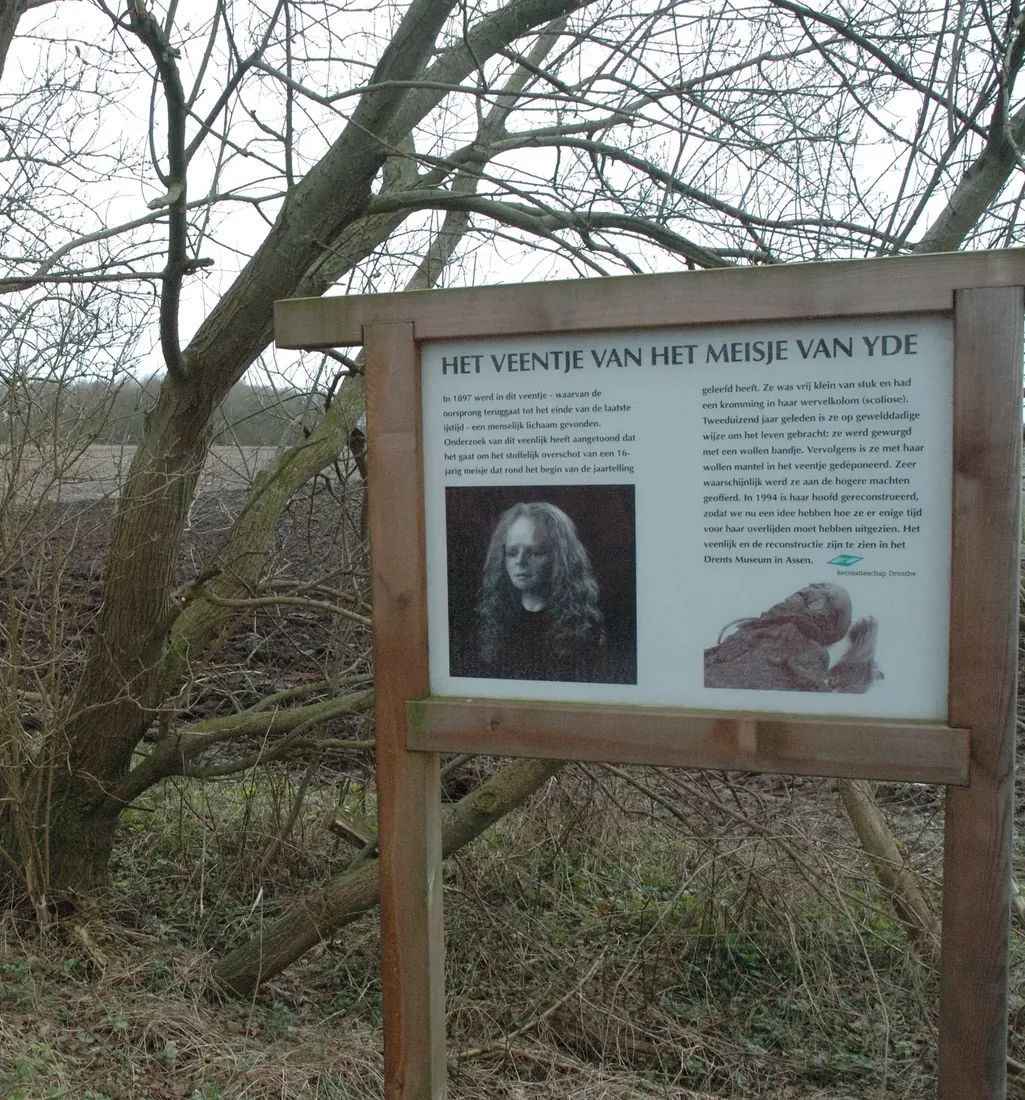
Near the village of Yde lay a small peatland where the remains of a young woman were found in 1897. An older photograph of an information board at the site opens this story. She is known as the Yde Girl. “Girl” is a name later generations gave her; we do not know her own name. In the Drents Museum in Assen, she is both a person from the past and an exceptional archaeological find. Her story calls for a distinction between what the remains reveal and what we are trying to understand about her life.
The museum dates her remains to approximately 40 BCE–50 CE, around the beginning of the Common Era. The object is registered as N1897-VI-1 and classed among organic finds. According to the object record, these are the remains of a human body about 140 centimetres long. Such details are concrete, but they do not make a complete life story. Her family, words and thoughts are unknown. The peat preserved material that would have disappeared in many other places, so something of her body remains after almost two thousand years.
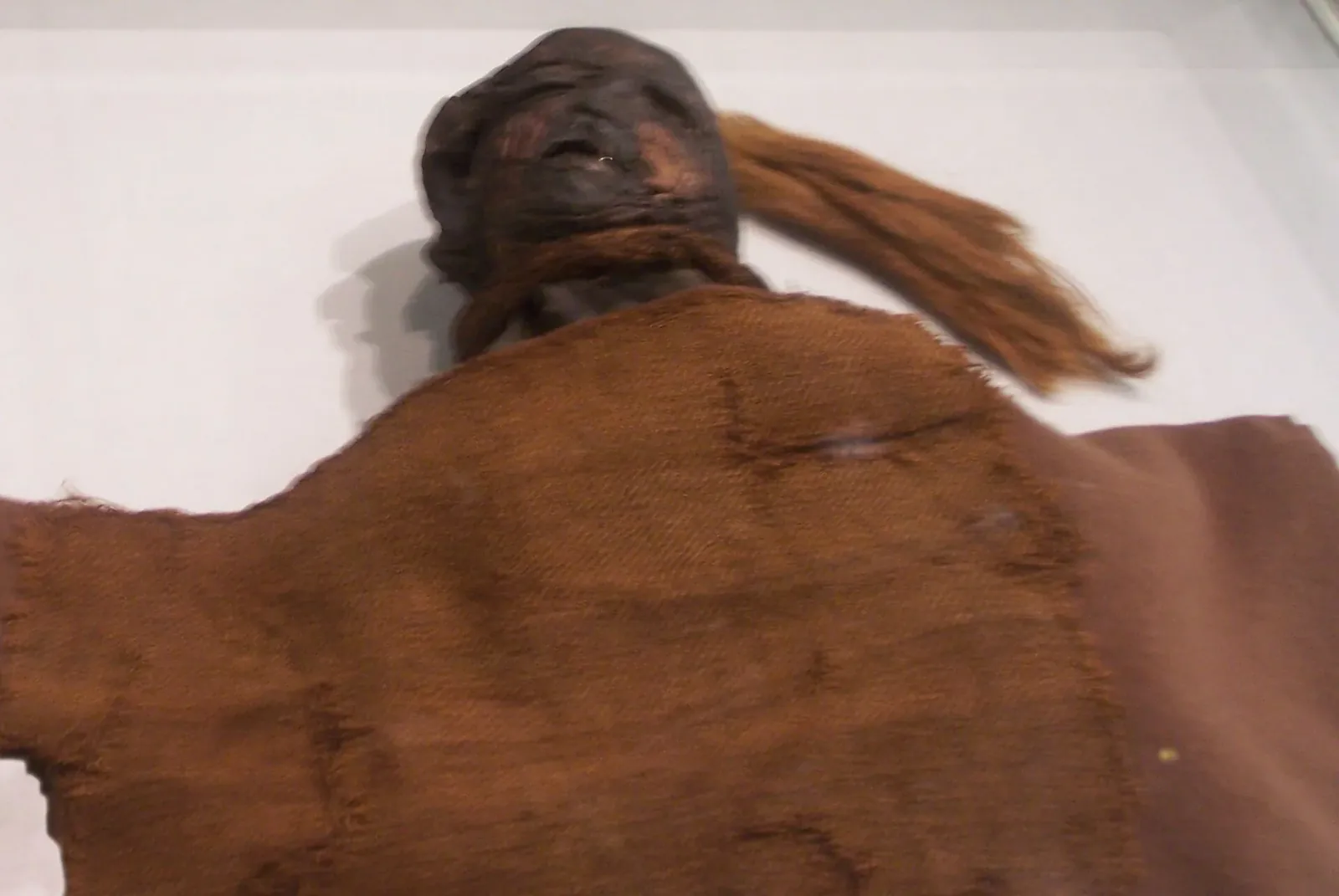

Two peat workers, Willem Emmens and Hendrik Barkhof, found her in May 1897 while dredging peat. The find came to the attention of the Provincial Museum in Assen at the time. According to the museum record, she was transferred to the museum on 19 June that year. That marks the beginning of her documented museum history, not of her own history. The distance between the two is great: the archive date can be established precisely, while the circumstances of her death are much less certain.
On its object page, the Drents Museum describes a scenario in which the young woman was sacrificed when her community sensed a Roman threat. The museum connects this account with Rome’s influence beyond the frontier of the empire, the limes. This is an interpretation used to place the find in history; the remains themselves do not tell us why this person died or exactly what her community thought. It is therefore more careful to speak of the museum’s interpretation than of an established explanation for her death.
The Yde Girl belongs to the archaeology collection alongside other peatland finds. The Drents Museum uses the collection to ask about prehistoric beliefs and treatment of the dead. She is also a key object for the Roman limes entry in the Canon of the Netherlands. One find thus enters wider stories about landscape, religion and contact between regions. Yet the personal mystery remains. Archaeological context can bring us closer without reducing her to a symbol.
According to the museum, the Yde Girl is currently on view in Labyrinthia, its continuing collection display across fifteen rooms. This presentation brings archaeology together with art and history. The Drents Museum warns of strong sensory stimulation, sound, moving images and dark areas. That matters to visitors sensitive to crowds or stimulation when deciding whether to enter the gallery.
The Drents Museum is at Brink 1, 9401 HS Assen. Its regular hours on Friday 16 October are 10 am to 5 pm. The dolmen builders and the wider archaeology collection are also the subject of a separate profile. Together, the subjects show how varied Drenthe’s traces are: monuments in the landscape, everyday objects from the ground and human remains that call for careful attention.