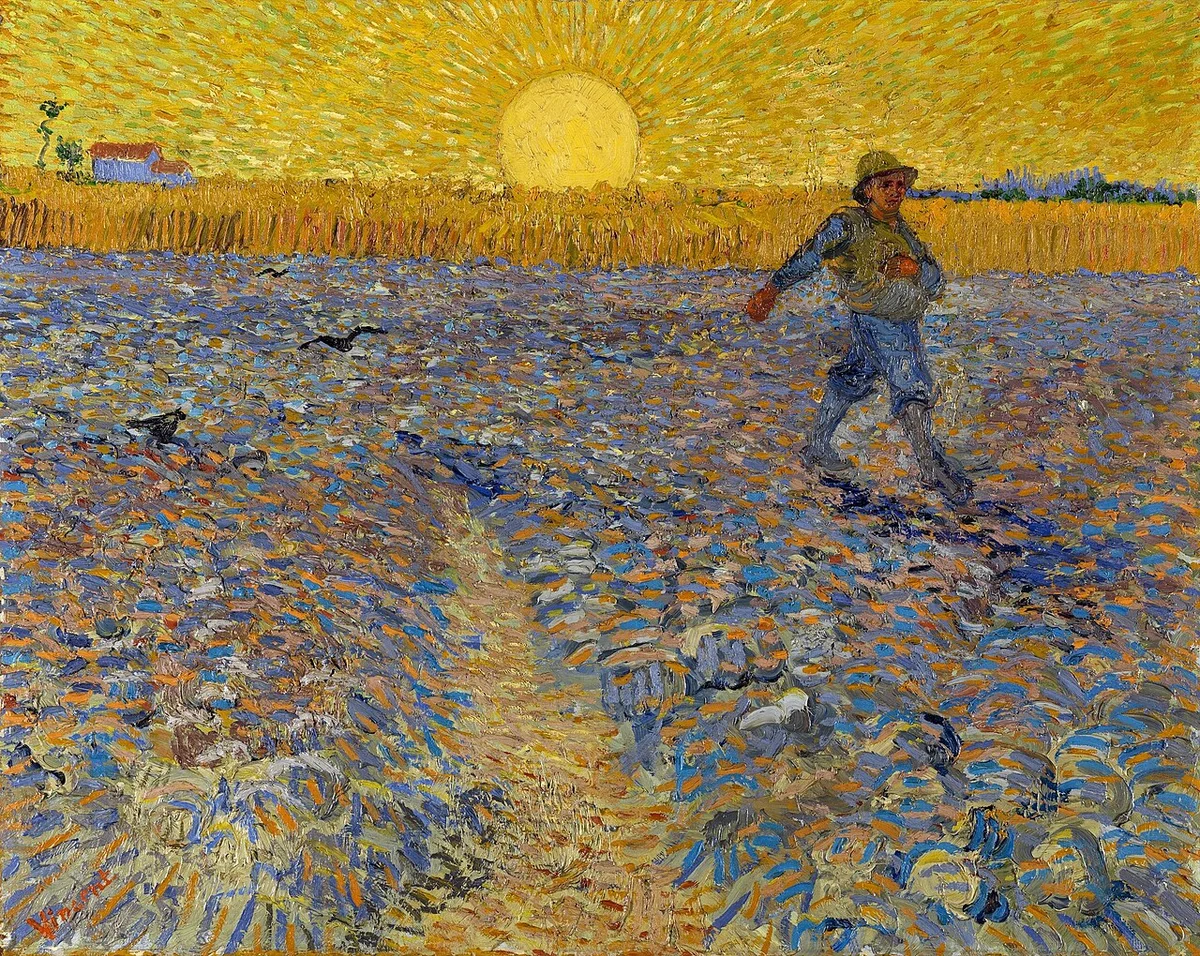
The Sower in the Kröller-Müller Museum, oil on canvas, 64.2 × 80.3 cm, was painted in Arles around 17–28 June 1888. Van Gogh knew Millet’s sower of 1850 and had drawn it dozens of times. In Arles he wanted a new version: not a dark grey field, but radiant colour and fierce contrast. The eye goes to the clods of earth, thickly laid on in blue-violet and orange, almost like relief. The sun hangs like a disc of energy above the sweep of the arm.
What stands out: behind the man who is sowing, ripe corn is still standing. The same canvas holds two moments in the life of the land. The museum reads this as the cycle of nature and life, and also notes a religious layer: the sower in the field as an image of the sower of the Word. That second layer is an interpretation that belongs to the motif, not an extra scene you can point to in the paint. First comes the gesture. Then the echo.
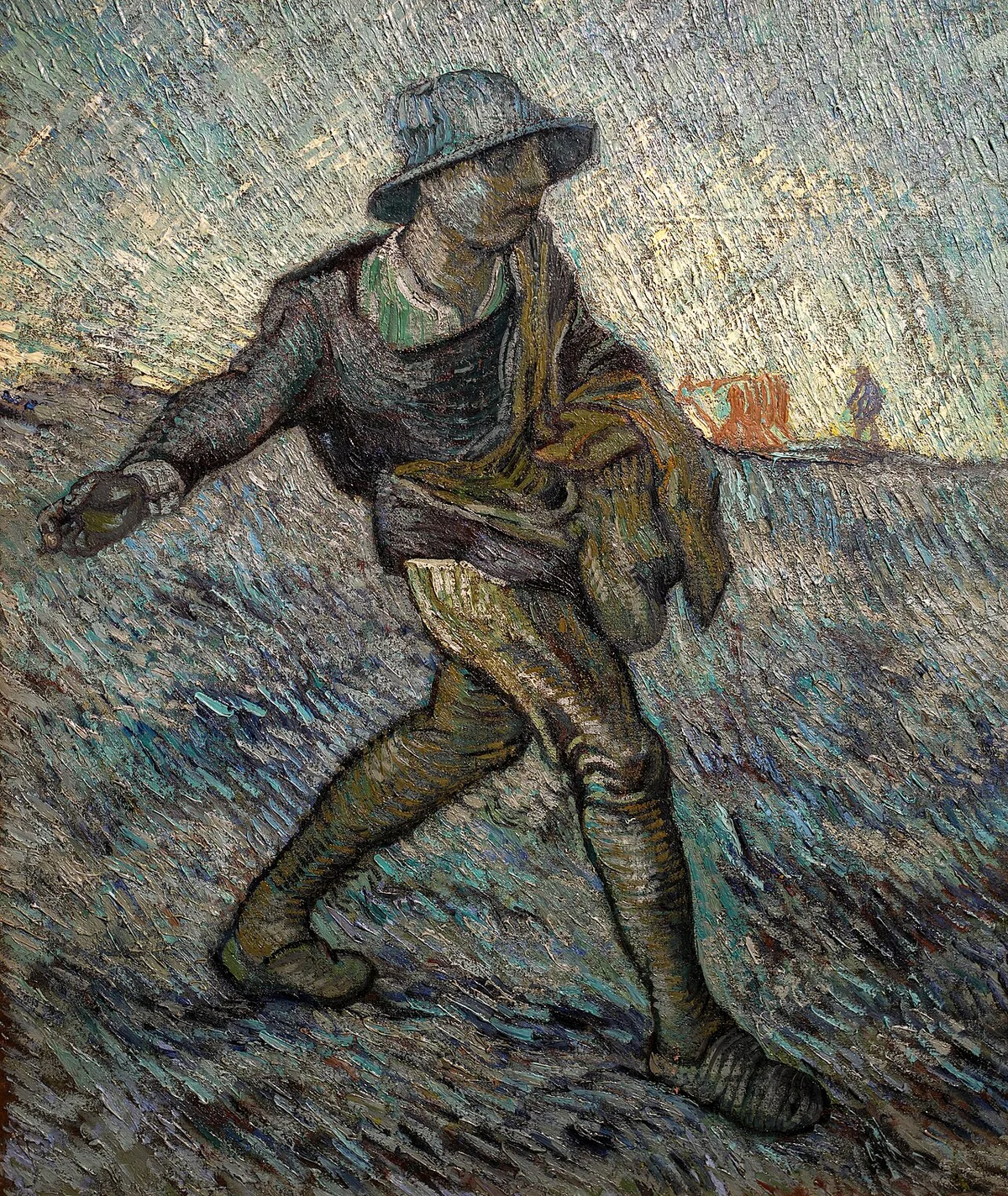
Vincent van Gogh, The Sower (after Millet), Saint-Rémy, 1889. A later version for comparison with the painting of June 1888.
Behind this sower of June 1888, Van Gogh leaves the ripe corn standing, on the same canvas as the ploughed land.
Cover the sun. If the arm still reads clearly, the figure carries the picture. Cover the corn. Does sowing then become mere work, without that second moment in the field?