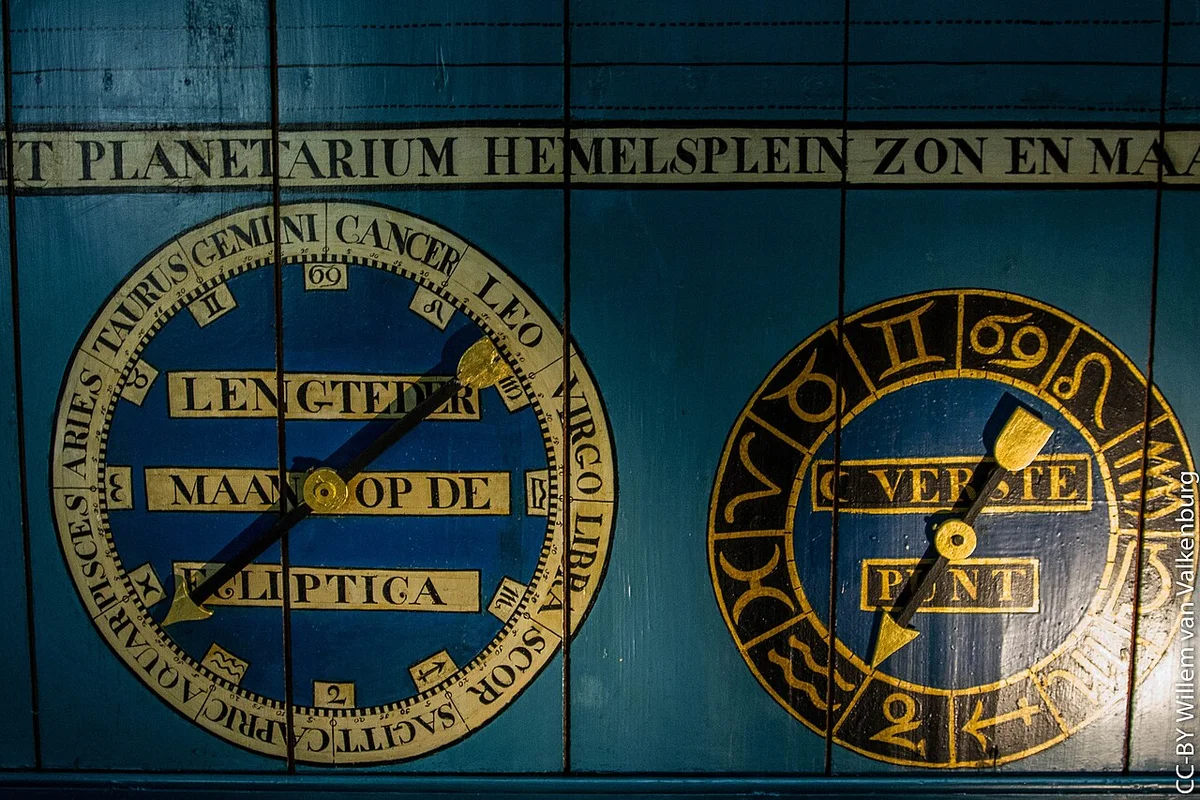
Eise Eisinga, a wool comber in Franeker, began work in his house in 1774 on a moving model of the solar system as it was known at the time. By 1781 it was finished: the sun, moon, earth and the five known planets — Mercury to Saturn — to scale, built into the ceiling and south wall of the living room. In that same year, 1781, William Herschel discovered Uranus; that planet is therefore not in the original gearwork. UNESCO calls it the oldest still-working planetarium of this kind. You are standing in a room. Above your head, the distances tick away.
The house dates from 1768. Eisinga used the room beneath it as a place for explanation, just as a modern planetarium has a hall beneath its dome. The gearwork has remained in operation almost without interruption. Repairs were needed; the principle stayed. Look up at the golden spheres and at the numbers along the edge. This is not a starry sky to lie beneath. It is a clock of orbits, meant to be followed standing up: where is Jupiter this week, how far away is the earth.
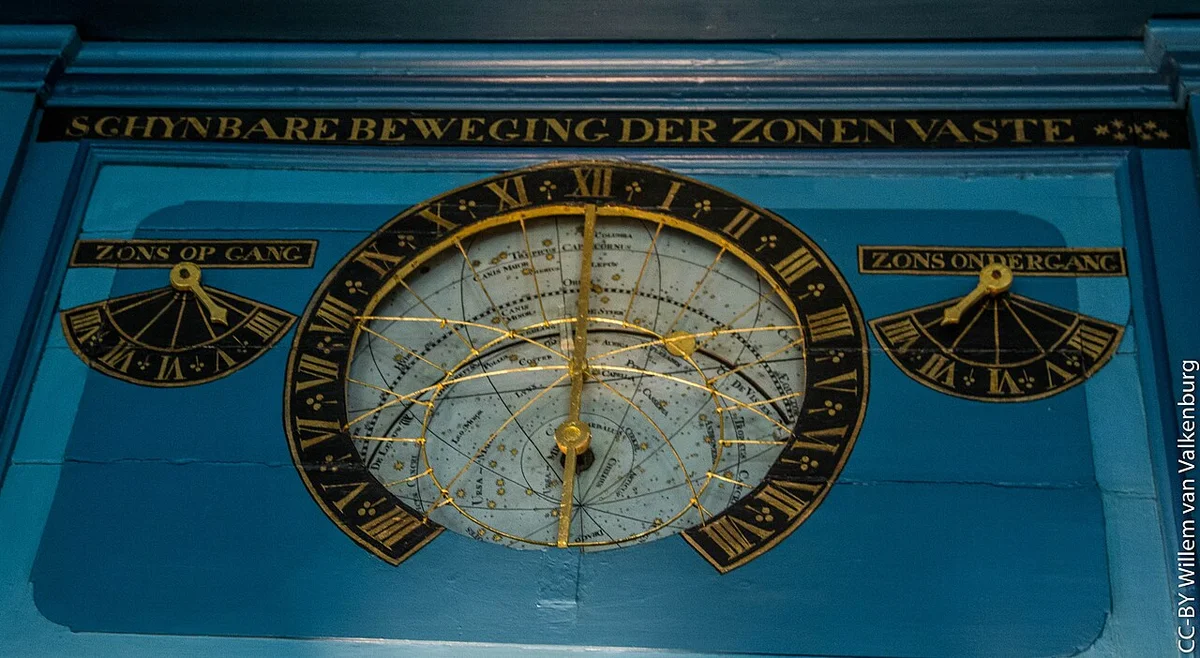
Follow one planet a little way along its ring. Its slowness is the lesson: distances are time.