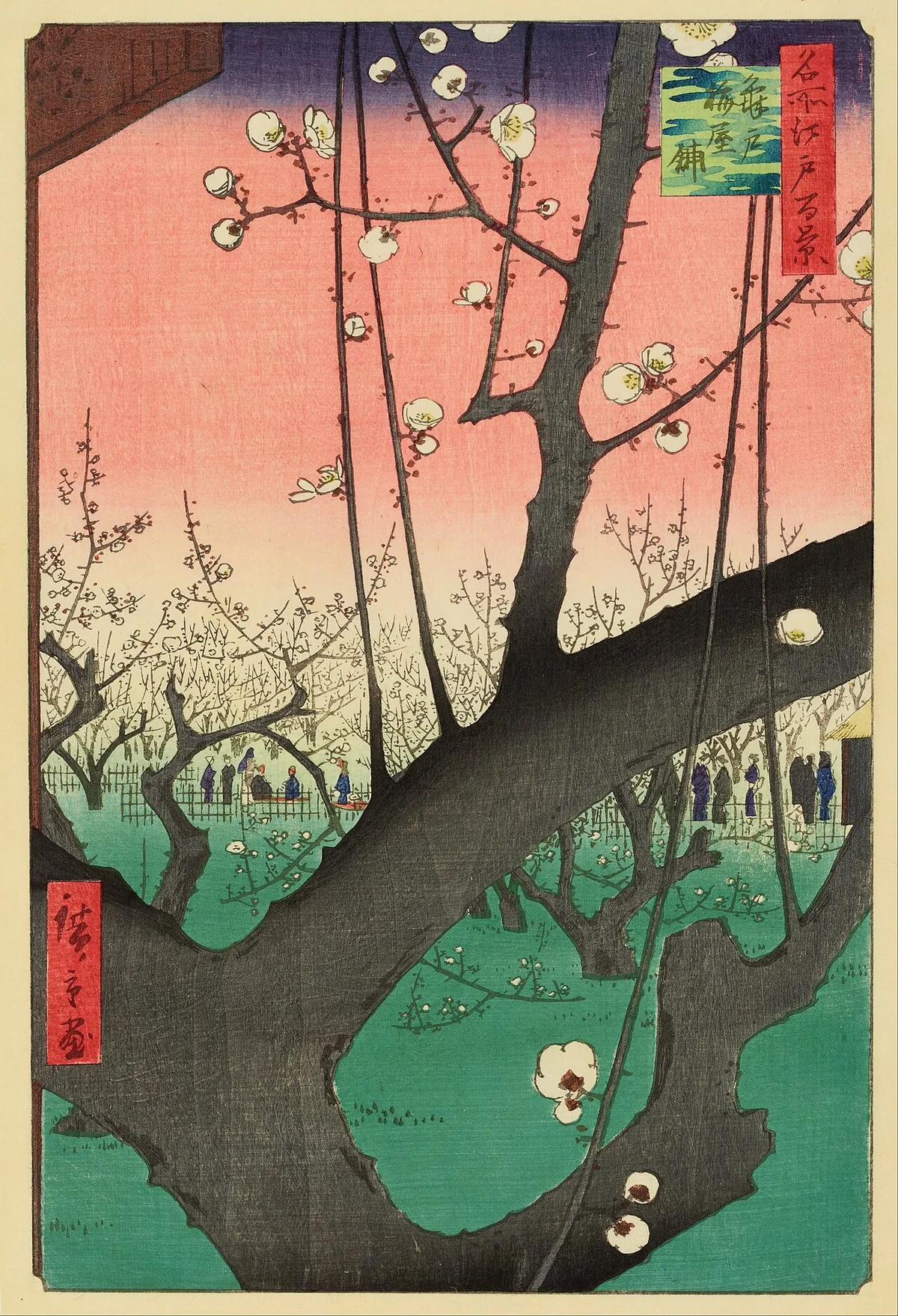
The Van Gogh Museum holds hundreds of Japanese prints that Vincent and Theo collected. Vincent translated motifs by Hiroshige, among others, into oil paint. What drew him, he wrote himself: clear contours, large fields of colour, little shadow. That is his reading of those particular sheets. A shop full of woodcuts is not one single trick. Some prints foreshorten a road or set Fuji small in the distance. Others press a blossoming branch flat against the paper, with almost no ground plane.
So look only at the sheet hanging in front of you. Driving rain on a bridge can suggest depth with diagonals and a distant view. A wave or a branch, by contrast, can close the space up into a pattern. Van Gogh borrowed what he needed: a hard edge, an unmixed band of colour, a motif that runs right up to the frame. The portfolio in Paris explains how the prints came into the house. The painting beside it shows which lesson he picked up that week.
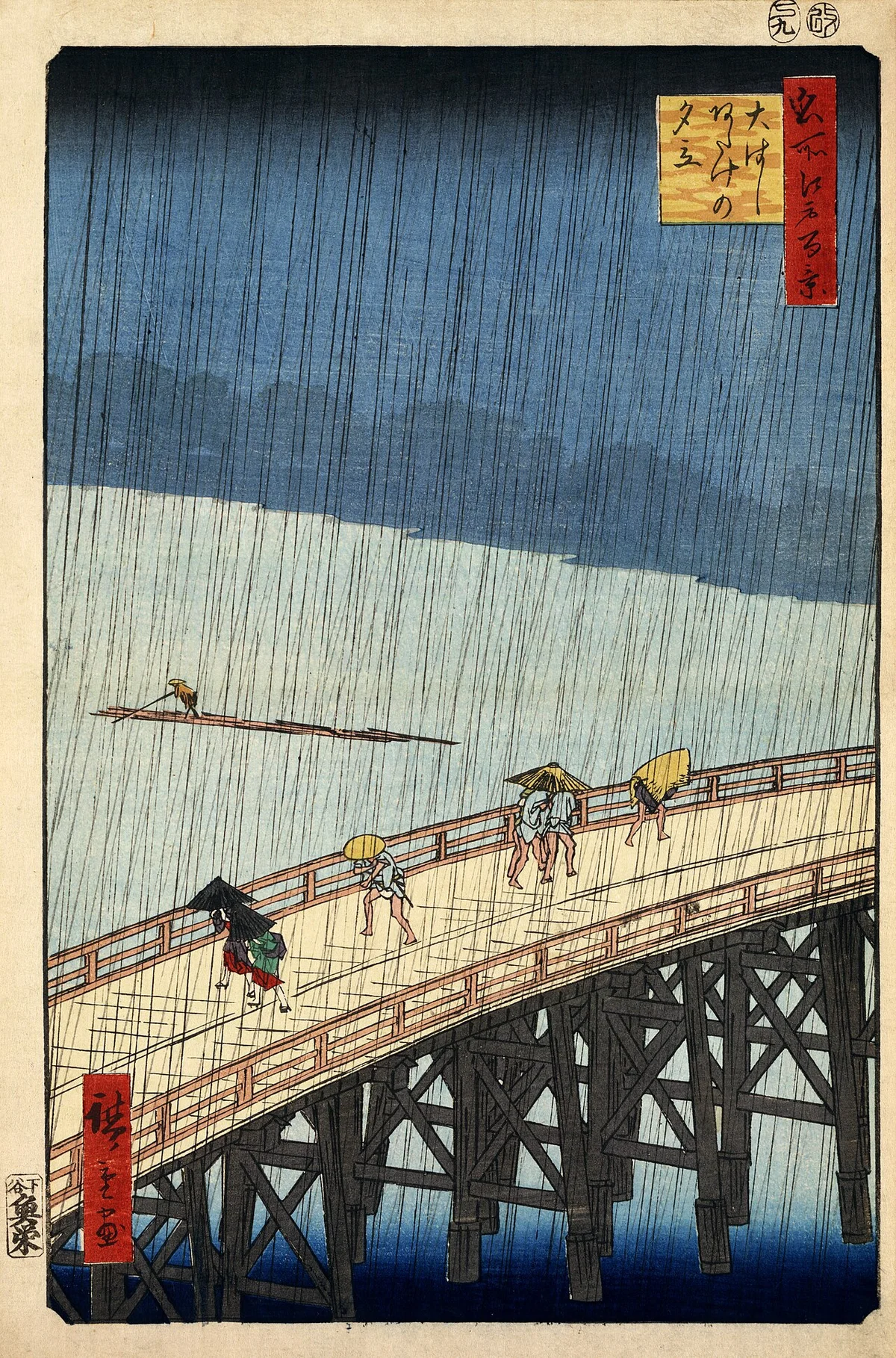
Utagawa Hiroshige, Sudden Shower over Shin-Ōhashi Bridge and Atake, 1857.
If the motif stops abruptly, the sheet is a crop. If a road runs out of the frame, there is space behind the paper. Both kinds hung in the same collection.